

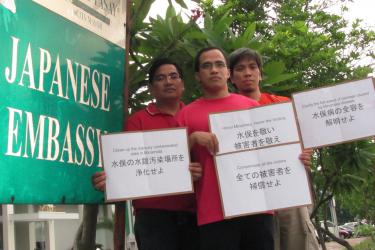
In response to the court judgment yesterday in Japan rejecting claims by seven survivors from Minamata who suffer from mercury poisoning, IPEN reiterates our solidarity with the survivors and calls for justice for all Minamata victims.
The seven Minamata plaintiffs sought a court ruling to include them as Minamata Disease victims under Japan’s Pollution-Related Health Damage Compensation Act. Minamata disease was first recognized in the mid-1950s, as a result of years of mercury dumping by Chisso Corporation, a chemical company located in Minamata. The dumping contaminated seafood in Minamata Bay, poisoning local residents for decades and causing health problems across generations.
Now seven decades on, Minamata mercury poisoning survivors, well into their 70s, still face a grueling battle for recognition, relief, and justice. Almost nine years after the Minamata Convention on Mercury entered into force, the victims of the mercury poisoning tragedy for which it is named are still waiting for full justice and resolution.
IPEN fully supports the righteous cause of the Minamata disease survivors and their support groups. We support their demands for recognition, fair compensation, and the implementation of a healthcare system to ensure their long-term well-being and security.
IPEN actively participated in the development of the Minamata Convention and has contributed to the negotiations at every session since its first intergovernmental negotiating conference. IPEN advocates for a healthy and toxics-free future, and more than 110 IPEN members are currently gathered in Puerto Princesa City, Philippines, for the IPEN Global Meeting.
A recent article finds most Minamata disease survivors feel the harms from the pollution in their town have yet to be fully resolved.
To the Minamata disease sufferers and your support groups, you are not alone! We stand by you in your struggle for healing and justice.
Learn more about IPEN’s work on the Mercury Treaty.
 English
  简体中文
简体中文  Français
  Bahasa Indonesia
  Русский
  Español
  العربية
  Shqip
Shqip  Հայերեն
  Azərbaycan dili
  Беларуская мова
  Български
  Cantonese
  Hrvatski
  Čeština
  ქართული
  Deutsch
  Ελληνικά
  हिन्दी
  Қазақ тілі
  한국어
한국어  Кыргызча
  Bahasa Melayu
  नेपाली
  Português do Brasil
  Kiswahili
  Svenska
  Tagalog
  தமிழ்
தமிழ்  ไทย
ไทย  Українська
  Tiếng Việt