

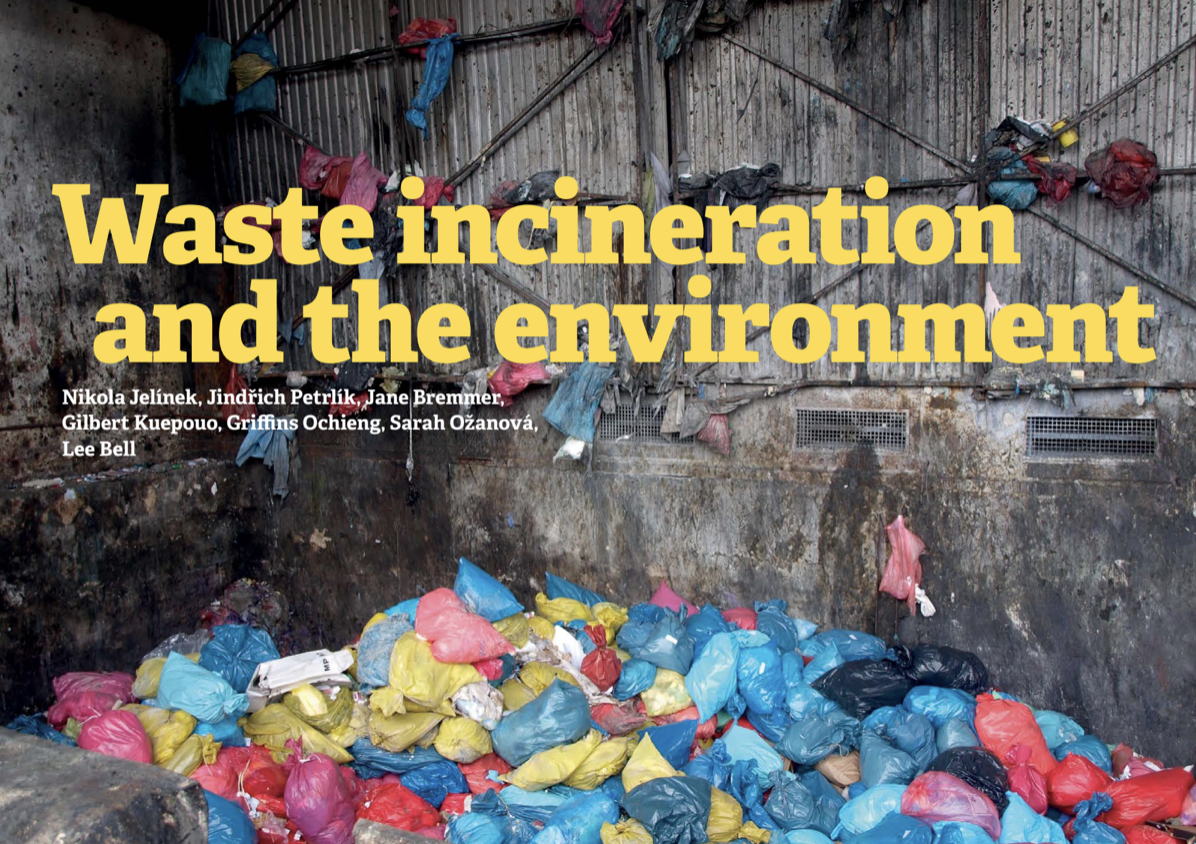
A comprehensive new report “Waste incineration and the Environment” released today by Arnika, the Centre for Environment Justice and Development (CEJAD) in Kenya, Centre de Recherche et d‘Education pour le Développement (CREPD) in Cameroon, Toxics Free Australia (TFA), and IPEN finds that burning waste, especially plastics, produces unsustainable and unmanageable hazardous air emissions and large amounts of highly toxic solid residues (ash), concluding that alternatives to incineration should be implemented globally. Given the challenges faced by the triple planetary crisis of biodiversity loss, climate change, and toxic pollution, the report finds that waste incineration contributes to all three of these interlinked problems.
“Waste incineration and so-called waste-to-energy incinerators are toxic minefields for nearby communities and produce toxic emissions and wastes that threaten the planet,” said Jindřich Petrlík, co-author of the study and the Toxics and Waste Programme Director at Arnika. “Incinerator fly ash is a highly hazardous waste that contains some of the most toxic chemicals known, and it is better to avoid its generation than to deal with its disposal. Instead of polluting technologies like incineration, we need zero-waste policies that include waste prevention, re-use, better collection and sorting, composting, recycling and safe non-combustion residual waste disposal technologies for truly circular waste management solutions.”
According to the World Bank, about 11 % of waste produced globally is incinerated, although the figure is higher for plastic waste, with UNEP finding that 17% of plastics are incinerated. Burning plastics and other materials produces dioxins, a group of globally banned chemicals that are known as the most toxic substances on the planet, with links to cancer, harm to reproductive health, immune system damage, and other serious health concerns. Incinerators create large amounts of solid waste (bottom ash) – rates of ash produced are as much as 30% of the weight of the waste going into a facility. Both fly and bottom ash from incinerators is highly contaminated with dioxins and other chemicals such as PFAS “forever chemicals,” polychlorinated biphenyls (PCBs), and other persistent organic pollutants, yet its disposal is largely unregulated. The amount of unregulated dioxins in fly ash exceeds the maximum tolerable intake for dioxins for the entire population of the planet by as much as 133 times.
Communities living near incinerators may be most at risk from their harmful effects on health. A 2013 study looked at cancer mortality over ten years for residents near a waste incinerator, finding higher risks for several cancers. Other studies have found high rates of respiratory disease, miscarriage, premature birth and congenital abnormalities for those living near incinerators. Food contamination near incinerators is rarely studied yet a likely route of exposure to dioxins and other highly toxic chemicals. A 2021 study found that farmers living near an incinerator had higher blood levels of dioxins and other toxic chemicals than the general population of the area, likely due to their greater consumption of locally produced food. An IPEN study found that 24 of 26 pooled samples of free-range chicken eggs collected near incinerators in 12 countries contained dioxins and/or other highly toxic chemicals in excess of EU food safety limits.
“We have serious concerns about waste incineration and its threat to the environment and human health in African countries,” said Griffins Ochieng, Co-founder and Executive Director of CEJAD. “Waste disposal and especially the growing burdens of plastic waste are a significant problem that should be addressed at the source, by limiting plastic production.”
While negotiations for a global Plastics Treaty are scheduled to resume later this year, industry continues to promote plastic “chemical recycling,” waste-to-energy incineration, and plastic waste as fuel (called refuse-derived fuel or RDF). Today’s report notes that chemical recycling (sometimes called “advanced” recycling) has similar environmental impacts as incineration, as the technology produces large amounts of hazardous wastes and few useful outputs. Waste-to-energy incinerators also create problems equivalent to other incinerators, while incentivizing waste creation over more sustainable options of reuse and recycling.
“Plastic chemical recycling is a myth and should not be considered an environmentally safe way out of the plastics crisis,” commentsGilbert Kuepouo, Executive Director of CREPD. “Projections show that by 2050, burning plastic for energy could create more greenhouse gases than all fossil fuels produce. Incinerating waste for energy is inefficient and produces climate-destroying emissions that we cannot tolerate.”
Industry increasingly promotes waste incineration for the global South, particularly for Southeast Asia where it is most unsuitable. Australia has been criticized for promoting exports of plastic RDF to Southeast Asian countries despite a national ban on plastic waste exports. This year, the country reversed its position and now classifies RDF as hazardous waste that requires a hazardous waste permit for export, but the government continues to promote waste incineration.
“Using plastic waste for fuel will exacerbate the global waste crisis and push incineration projects into the Southeast Asian region, which would be a disaster for the climate, health, and the environment,” adds Jane Bremmer, Chair of TFA and coordinator of the Zero Waste Australia campaign. “We must avoid industry’s false solutions like waste incineration and instead invest in sustainable Zero Waste policies that promote a truly sustainable future.”
In addition to reviewing the science around waste incineration, today’s report includes numerous case studies from around the world demonstrating the failures of incineration and its threats to human health and the environment.
 English
  简体中文
简体中文  Français
  Bahasa Indonesia
  Русский
  Español
  العربية
  Shqip
Shqip  Հայերեն
  Azərbaycan dili
  Беларуская мова
  Български
  Cantonese
  Hrvatski
  Čeština
  ქართული
  Deutsch
  Ελληνικά
  हिन्दी
  Қазақ тілі
  한국어
한국어  Кыргызча
  Bahasa Melayu
  नेपाली
  Português do Brasil
  Kiswahili
  Svenska
  Tagalog
  தமிழ்
தமிழ்  ไทย
ไทย  Українська
  Tiếng Việt